

Frankincense, Sandalwood, and the Oils That Shift the Field
A frequency drop from the ZenShift Field
Author: ZenShift
Published: July 13, 2026
Estimated Read Time: 6 min read
Portal: ZenShift Apothecary
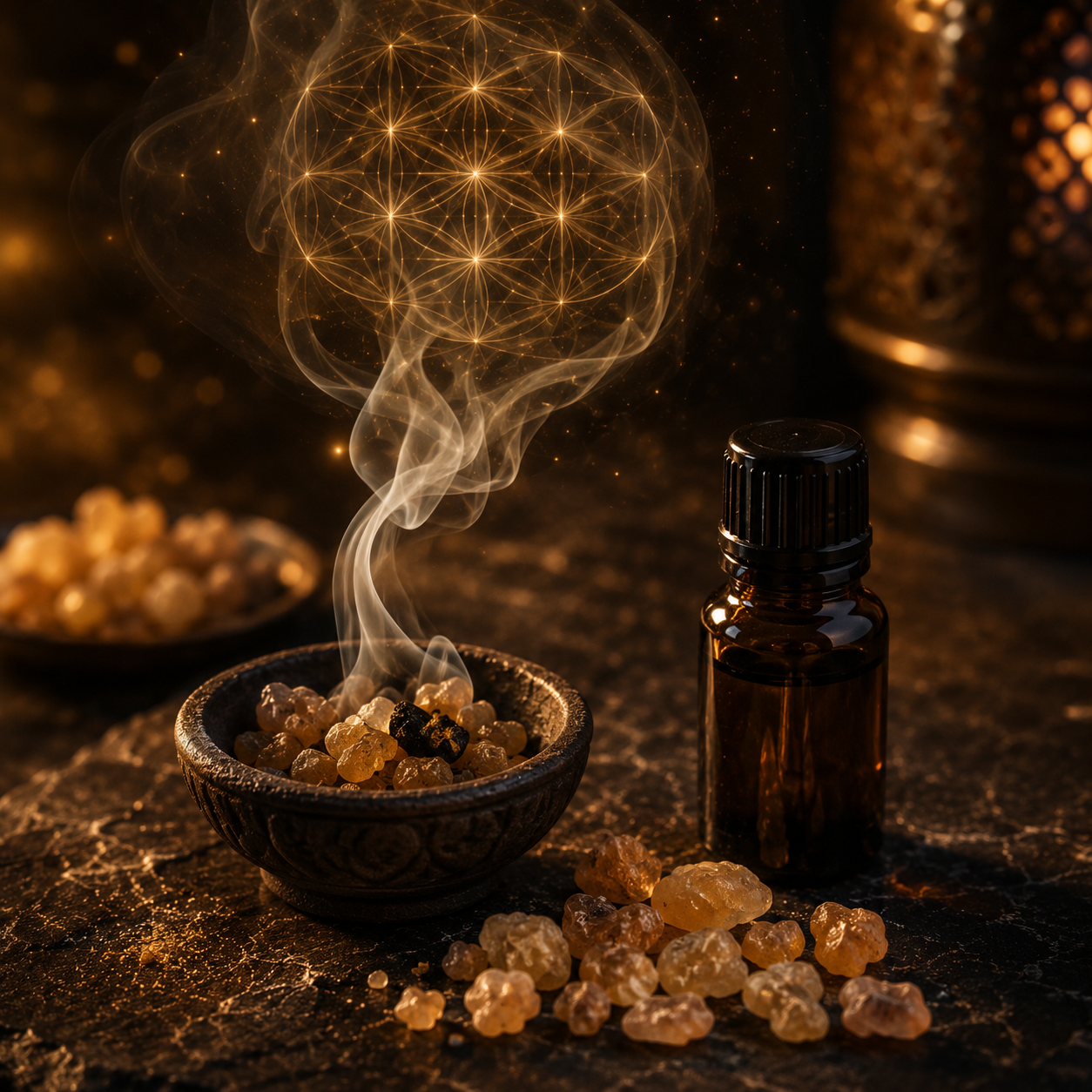
Some essential oils have been used in ceremony, in clearing, and in sacred practice for thousands of years, not because of tradition alone, but because of what they actually do to the energetic field of a space and a body. Here is what frankincense and sandalwood do, how to blend them, and how to carry them into daily practice.
Frankincense has been traded across continents for over five thousand years.
It appears in Egyptian ceremonial records, in Ayurvedic texts, in the Hebrew Bible, in Chinese medicine, in the incense offerings of virtually every major spiritual tradition that has left written documentation. It has been burned in temples, applied to bodies in preparation for burial, offered as a gift of extraordinary value, and used continuously in sacred practice across cultures that had no contact with each other.
That level of cross-cultural convergence over that span of time is not coincidence. It is evidence.
The question is not whether these traditions were onto something. They clearly were. The question is what, precisely, they were working with, and how to bring that understanding into a contemporary practice that is grounded rather than mystified.
What makes these oils different
Most essential oils work primarily through the olfactory system, the scent reaches the limbic system via the nose and produces physiological effects through that pathway. This is how lavender addresses sleep, how bergamot addresses anxiety, how the sleep oils discussed elsewhere in this portal do their work.
The ceremonial oils, frankincense, sandalwood, and a small set of related resins and woods, work through this pathway and through additional ones. They contain compounds that interact with the nervous system, the immune system, and the body's cellular repair mechanisms in ways that have been substantiated in modern research even while the traditional understanding predated that research by millennia.
They also have a quality of interaction with the energetic field of a space that goes beyond what their biochemical action alone would predict. This is where the language of frequency becomes useful, these oils have been used as field-clearing, field-anchoring, and field-elevating tools across traditions, and the consistency of that use across cultures suggests a real effect that the biochemical research is only beginning to characterize.
Frankincense: the field clearer
Frankincense, derived from the resin of Boswellia trees, contains boswellic acids and a compound called incensole acetate that has demonstrated significant effects on the brain and nervous system. Incensole acetate activates TRPV3 channels, receptors involved in warmth perception and emotional regulation, in ways that produce measurable reductions in anxiety and depression-related markers. It also crosses the blood-brain barrier, which most essential oil compounds do not, and has shown anti-inflammatory effects on neurological tissue.
But the traditional use of frankincense as a field-clearing agent points to something beyond its neurological effects. Burning frankincense, or diffusing the essential oil, has been used across traditions to clear energetic residue from a space before ceremony or practice. To raise the vibrational quality of an environment. To create the conditions for a particular quality of attention and presence.
In practical terms, this translates to using frankincense at the beginning of any intentional practice, before meditation, before a journaling session, before a healing or ceremony of any kind. Not as a superstition. As a deliberate signal to the field, and to the self, that the ordinary frequency is being set aside and a different quality of attention is being opened.
Diffuse it, burn the resin if possible, or apply a drop diluted in carrier oil to the third eye point, the center of the forehead, before beginning.
Sandalwood: the anchor
Sandalwood, particularly Santalum album, the true Indian sandalwood, is the grounding companion to frankincense's elevating quality. Where frankincense clears and lifts the field, sandalwood anchors it. It produces a quality of deep, embodied presence, a rootedness in the physical body and the present moment that the higher-frequency oils do not reach as directly.
Its primary active compounds, santalols, interact with olfactory receptors throughout the body, not only in the nose, producing a physical relaxation response that is distinct from the primarily neurological effect of most other oils. Sandalwood is also one of the most studied oils for its effects on mental clarity and meditative depth, multiple studies have found that sandalwood inhalation supports alpha brainwave activity, the state associated with relaxed, focused awareness.
In practice, sandalwood is the grounding element in any blend. It provides the anchor that prevents the energetic clearing and elevation of frankincense from becoming destabilizing. Together, the two oils create a field that is both clear and grounded, elevated but embodied.
Rosemary and lemongrass: activation and clarity
Not all ceremonial oils are settling in quality. Rosemary and lemongrass work in an activating register, they are the oils for clearing cognitive fog, activating the mental field, and bringing a quality of sharpness and clarity that the more sedating oils do not produce.
Rosemary has been associated with memory and cognitive clarity since ancient Greece, students wore rosemary garlands during examinations. Modern research has confirmed that inhaling rosemary essential oil produces measurable improvements in cognitive performance, working memory, and mental speed. Its primary active compound, 1,8-cineole, crosses the blood-brain barrier and inhibits the enzyme that breaks down acetylcholine, one of the primary neurotransmitters involved in memory and learning.
Lemongrass produces a sharp, bright, clarifying scent that most people experience as mentally activating and mood-lifting. It is less studied than rosemary but consistently reported as an effective tool for clearing mental heaviness, supporting focus, and producing a quality of energetic brightness that makes it useful at the beginning of creative or cognitively demanding work.
These two oils are morning and daytime tools, not appropriate for the pre-sleep ritual, but highly effective in a morning practice or a midday reset.
How to blend and carry
Blending essential oils follows a simple principle: top notes, middle notes, and base notes.
Top notes, lemongrass, bergamot, rosemary, are the first scents perceived, volatile and bright, that lift quickly. Middle notes, lavender, frankincense, are the body of the blend, what emerges as the top notes settle. Base notes, sandalwood, cedarwood, vetiver, are the foundation, the slowest to volatilize and the longest lasting.
A field-clearing and grounding blend for a morning or sacred practice: frankincense as the middle note, sandalwood as the base, rosemary as a top note for mental activation. In a 10ml roller bottle with a carrier oil such as jojoba: 8 drops frankincense, 6 drops sandalwood, 4 drops rosemary.
A settling and presence blend for meditation or evening practice: frankincense as the middle note, sandalwood as the base, lavender as a softening middle note. 8 drops frankincense, 6 drops sandalwood, 5 drops lavender.
Apply to pulse points, wrists, temples, sternum, or diffuse in the space before the practice begins. The oils are setting the field. The practice that follows enters an environment that has already been prepared.
That preparation is not ceremony for its own sake. It is the recognition that the quality of the container determines the quality of what happens inside it.