

What Are Limiting Beliefs About Money — and How to Find Yours
A frequency drop from the ZenShift Field
Author: ZenShift
Published: June 13, 2026
Estimated Read Time: 4 min read
Portal: ZenShift Abundance
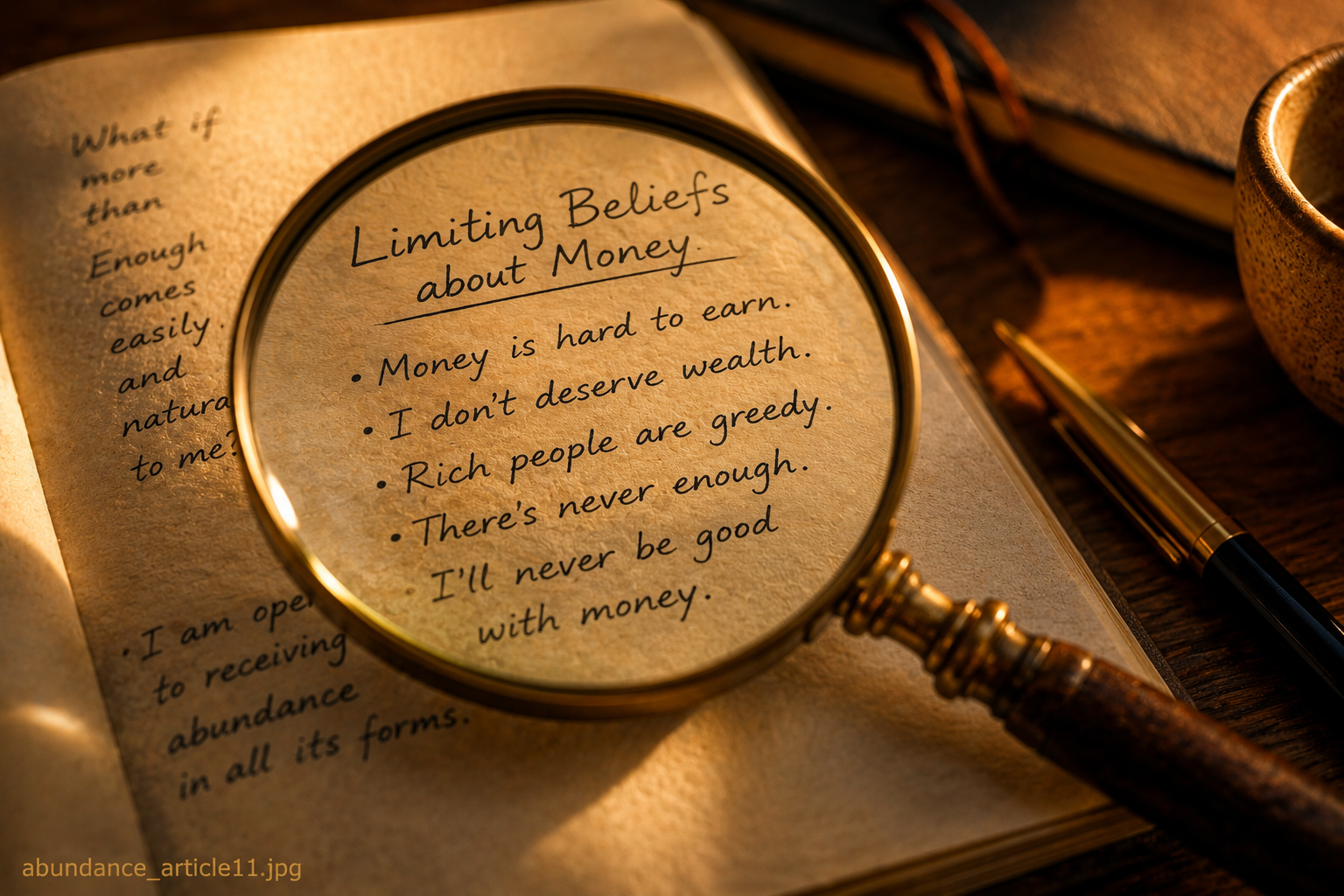
Limiting beliefs about money are the beliefs that quietly constrain what you allow yourself to earn, keep, and receive. Most people have them. Few people can name them specifically. At ZenShift, naming them is the first step in updating them. Here is how to find yours.
What limiting beliefs about money actually are
A limiting belief about money is any belief that constrains what you allow yourself to earn, keep, receive, or expect financially.
The word limiting is doing real work in that definition. These are not simply beliefs that are pessimistic or negative. They are beliefs that actively restrict the range of financial experience your system considers possible or appropriate for you specifically.
And that restriction happens below the level of conscious intention. You can want financial abundance sincerely while a limiting belief operates underneath that wanting and quietly contradicts it at every turn.
What limiting money beliefs sound like
Some arrive as explicit statements you can hear yourself thinking. Money is the root of all evil. Rich people are greedy. I am not good with money. I always end up broke. People like me do not get wealthy.
Others are subtler. They show up not as thoughts but as behavioral patterns. The reflexive underselling of your work. The discomfort when a bill is larger than expected, even when the account can cover it. The inability to fully receive financial good news without immediately anticipating what might take it away. The guilt that arrives with spending on yourself.
Both forms are limiting beliefs. The explicit ones are easier to work with because they can be examined directly. The behavioral ones require more attention to surface, but they often carry more charge.
The most common limiting money beliefs
There is never enough, and there probably will not be. This is the foundational scarcity belief. It does not require active thought to operate. It runs as a background frequency that colors every financial experience.
Money is hard to make and easy to lose. This belief creates a particular quality of grip around money: the sense that it is always in danger of disappearing, that financial security is inherently fragile.
I have to earn the right to have money. Often inherited from environments where worth was conditional. Produces overwork, undercharging, and difficulty receiving money that does not feel sufficiently earned.
Wanting a lot of money makes me a bad person. This belief creates a ceiling. The person who holds it will unconsciously limit their financial growth to stay within the range that feels morally acceptable.
My family was not wealthy, so I probably will not be either. An identity-level belief. Positions financial trajectory as fixed by origin rather than by choice and action.
How to find yours
Complete these sentences without thinking too hard. Write the first thing that arrives.
Money is... People who have a lot of money are... I would have more money if... The reason I am not wealthier is... When I imagine having significantly more money, I feel...
The answers reveal the operating beliefs. Not the ones you endorse consciously, but the ones that are actually running.
Once you can see them clearly, the next question becomes: where did this belief come from, and does it still reflect something real?
Most limiting money beliefs made sense in the context where they formed. They are not permanent truths about money or about you. They are inherited programs that can be updated.
What comes after identification
Clarity without action stays intellectual. The limiting belief shifts through accumulated evidence to the contrary.
Start small. Identify one limiting belief and one small action that contradicts it. Not a dramatic gesture. One moment of choosing from a different signal. Charging more than feels comfortable. Receiving a compliment about your financial decision without deflecting. Allowing a purchase you planned for to feel good rather than guilty.
Each of those moments is evidence. And evidence, accumulated over time, is what actually updates the belief.